Manufacturer: 3D printed
Scale: 1/100
Additional parts: HO scale model train roads and trees
Model build: Apr - May 2022
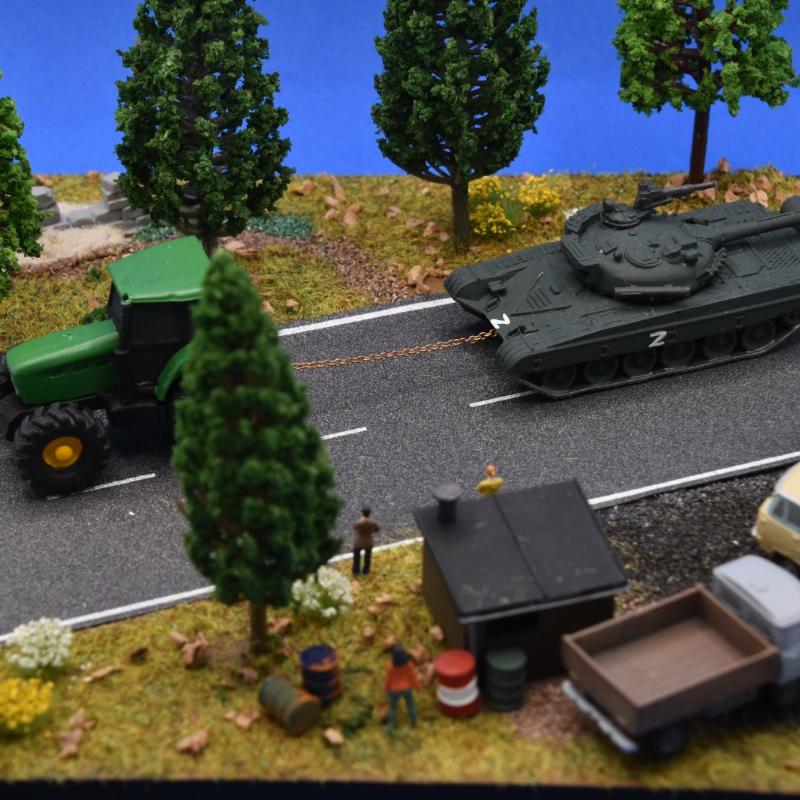
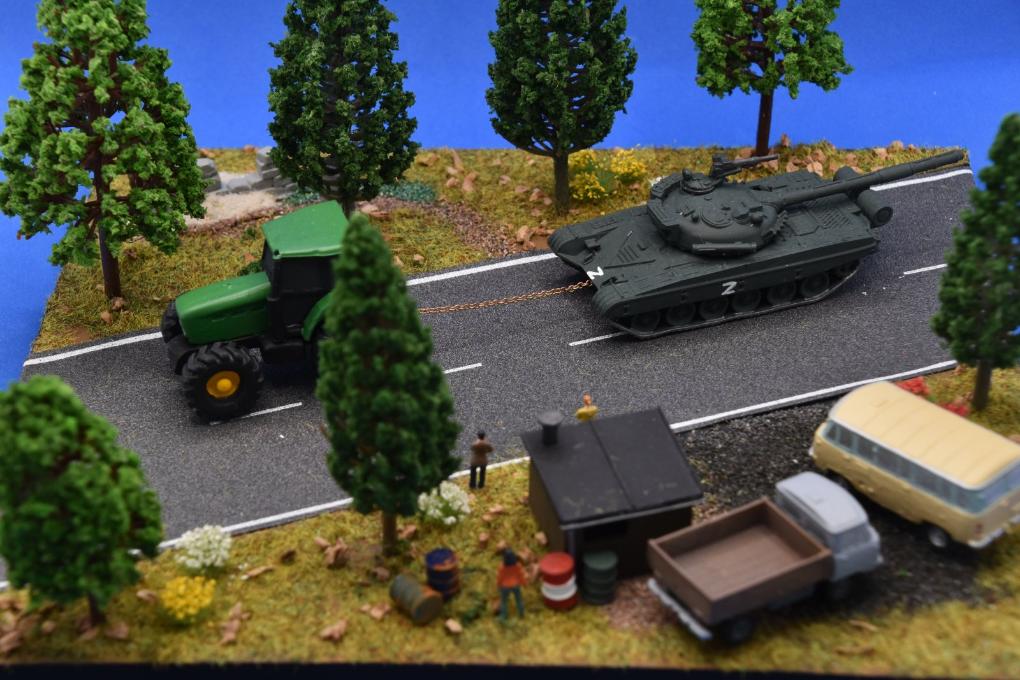
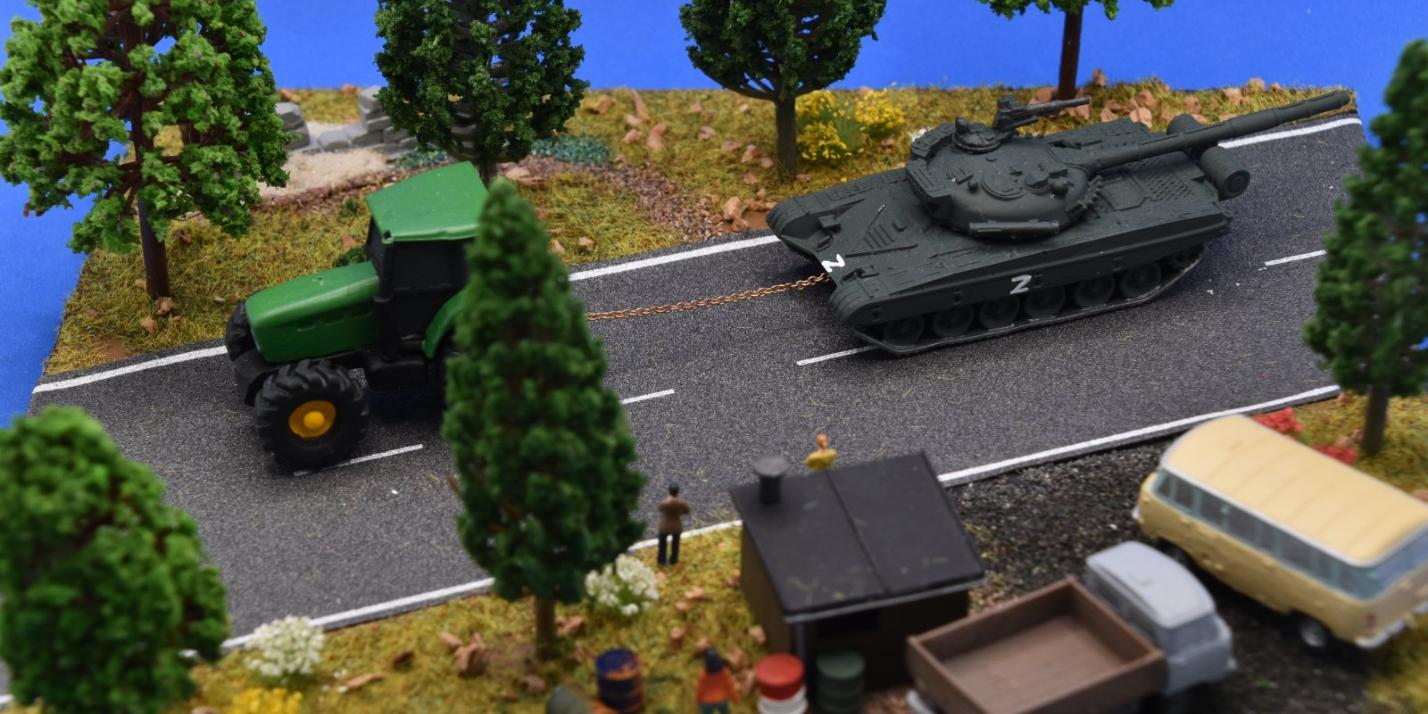
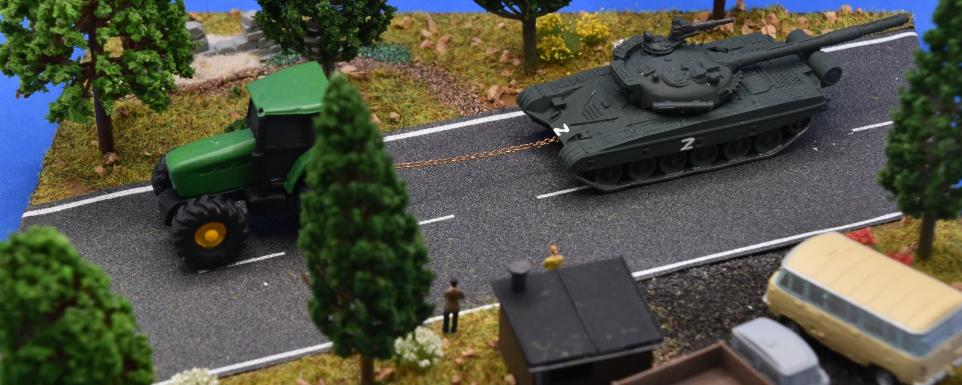
Manufacturer: 3D printed
Scale: 1/100
Additional parts: HO scale model train roads and trees
Model build: Apr - May 2022
Ukraine, Summer 2022
In the remote woodlands of north-eastern Ukraine, far from the noise of cities yet not untouched by the turmoil of war, three biologists had established a temporary research outpost. Their names were Alina, Sophia, and Igor—field specialists in large mammal behavior, brought together by a peculiar and urgent assignment.
A brown bear had been reported in the region—nothing unusual in itself—but this one behaved differently. Villagers spoke of an animal that lingered near roads and settlements, observing people rather than avoiding them. It had shown no aggression, no attacks had been reported, but its curiosity was unsettling. A bear that lost its fear of humans could quickly become dangerous.
The team operated out of a small wooden cabin at the edge of a dense forest. Their equipment was modest but sufficient: cameras, tracking gear, tranquilizer rifles—and two aging but reliable UAZ-452 vans, perfectly suited for the rough terrain. Day after day, they combed the surrounding area, following tracks, setting up observation points, interviewing locals. Yet the bear remained elusive, as if it was always just one step ahead.
But the wilderness was not their only concern.
Since the events of February 2022, the region had become unpredictable and hazardous. Military movements, abandoned vehicles, and the distant echo of conflict were constant reminders that this was no ordinary field study. Every trip into the forest carried risks far beyond wildlife encounters.
Then, one morning, something unusual broke the stillness.
The three researchers were awakened by a deep, rumbling noise—metal grinding, an engine straining under immense weight. It was far too loud, too heavy to be any normal farm vehicle. They stepped outside the cabin, the morning mist still clinging to the trees, and were met with a surreal sight.
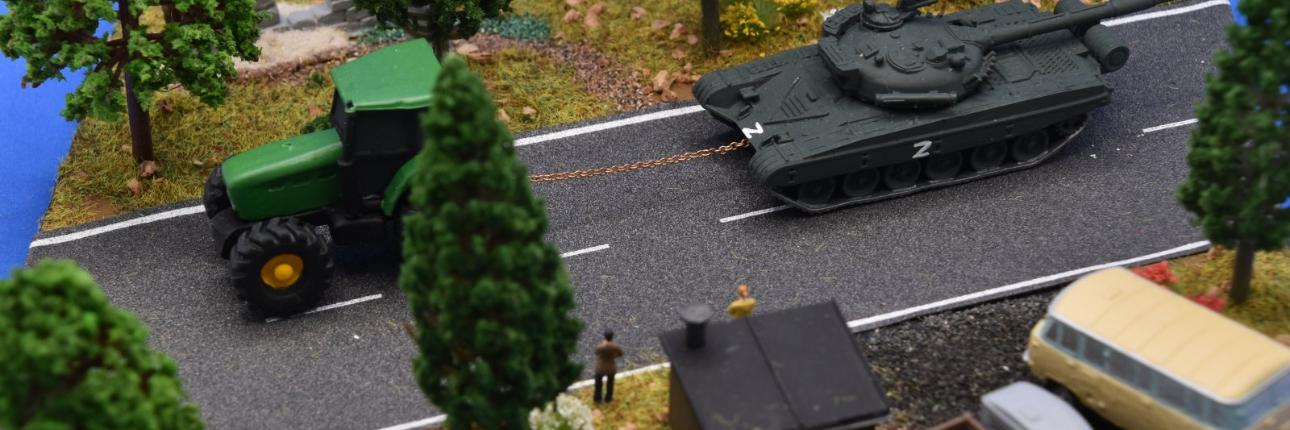
A large green tractor was slowly making its way down the road. Behind it, chained and dragging through the dust, was a tank.
Even from a distance, it was unmistakable—a Russian vehicle, marked with a crude white “Z” on its side. Its turret sat silent, its tracks lifeless, reduced from a weapon of war to a trophy being hauled away by a local farmer. The absurdity of the scene was almost unreal: a civilian tractor reclaiming a machine built for destruction.
The biologists stood in silence, watching the unlikely procession pass.
Then Igor pointed across the road.
There, partially hidden behind a low, crumbling stone wall, stood the bear.
It was massive—larger than they had imagined. Rising onto its hind legs, it watched the tractor and its strange cargo with calm, almost thoughtful attention. There was no fear in its posture, no agitation. If anything, it seemed… fascinated.
For a moment, time felt suspended. Human conflict, scientific mission, and raw wilderness all intersected in that single, quiet observation.
The tractor rumbled on, the tank scraping along behind it, until both disappeared around a bend in the road.
The bear lingered a few seconds longer.
Then, without a sound, it dropped back onto all fours, turned, and vanished into the forest.
Despite continued efforts, Alina, Sophia, and Igor never saw it again.
Somewhere in those vast woods, the curious observer remained—watching, perhaps, from a distance, as humans carried on with their strange and noisy affairs.
The current situation in Eastern Europe is nothing to make fun of.
With all the pictures and videos seen now there was one thing that was so ridiculous that I could not resist to build something like that.
This diorama combines 3D printing methods with classic model railway components to create a compact, highly detailed scene in approximately 1:100 scale.
The core of the build is the terrain base, which was designed digitally and produced using an FDM printer.
All major scene elements, including the tractor, tank, figures, and small structural details, were created using resin (SLA/DLP) 3D printing. This method was chosen for its ability to reproduce fine details such as surface textures, panel lines, and small mechanical components.