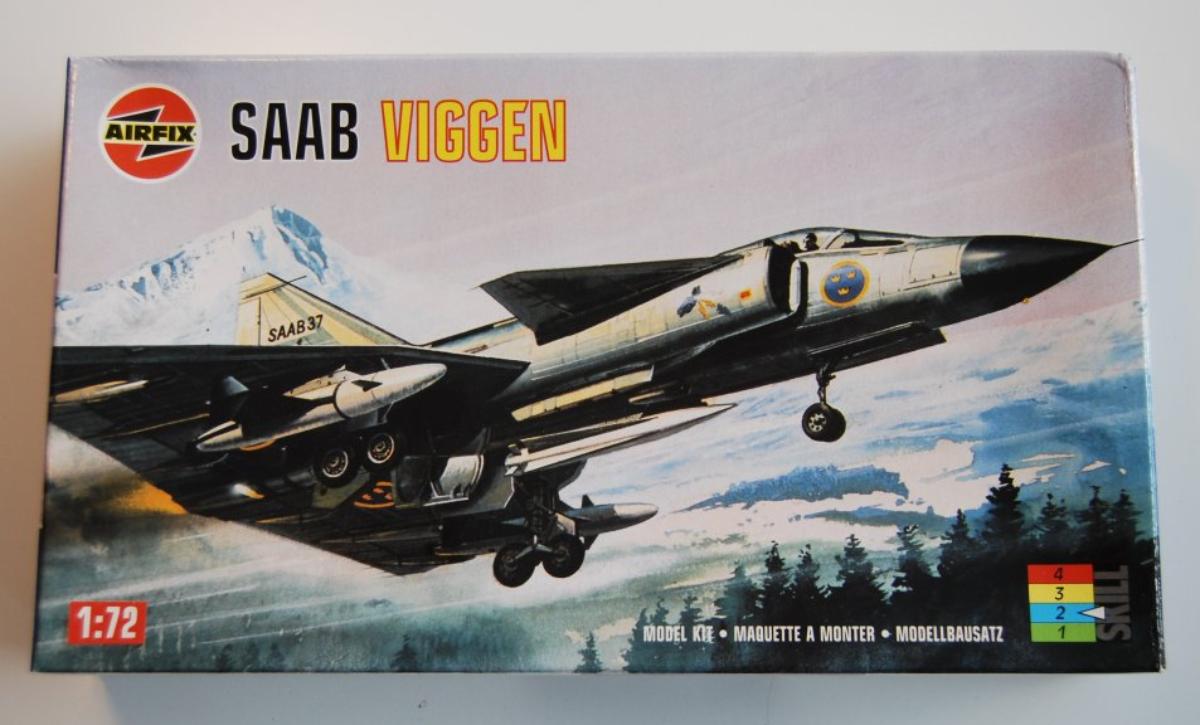
Manufacturer: Airfix
Scale: 1/72
Additional parts: HeHan decals
Model build: Feb-May 2018
Manufacturer: Airfix
Scale: 1/72
Additional parts: HeHan decals
Model build: Feb-May 2018
The sun beat down on Colonel Erich Kessler's neck as he surveyed the sprawling German countryside from the open cockpit of his Saab AJ37G Viggen. May 1983, and the air shimmered with heat, a stark contrast to the icy chills the plane usually handled. Today wasn't about air skirmishes, though. Today, Colonel Kessler was leading a squadron of Viggens in a massive air-to-ground exercise – a simulated strike mission on a mock enemy base nestled amongst the rolling hills.
Erich gripped the control stick, the familiar weight grounding him. Beside him, Major Schmidt chuckled, his voice crackling over the intercom. "Ready to show these rookies a thing or two, Colonel?"
Erich snorted. "We'll see about that, rook. Though, I wouldn't mind if you kept up this time." Their playful rivalry was legendary. Behind them, the two other Viggens, piloted by Captain Hoffman and Lieutenant Müller, roared to life, falling into formation.
Erich took a deep breath. This wasn't just about competition. The Viggen, with its deadly combination of speed, precision, and maneuverability, was the backbone of the Luftwaffe's air-to-ground attack force. Today, they were honing those skills to a razor's edge.
As they skimmed the treetops, the mock enemy base came into view. Smoke plumes billowed from simulated burning buildings, adding a layer of realism to the exercise. Erich's eyes narrowed. They needed to be fast, coordinated, and ruthless.
"Schmidt, take point. Hoffman, cover our right flank. Müller, stay with me," he barked into the comms. The four Viggens surged forward, a blur of grey against the green landscape. Anti-aircraft fire – simulated, of course – erupted from the base, tracers stitching the sky.
Erich weaved his aircraft, dodging the virtual flak with practiced ease. He wasn't just focused on avoiding fire – he needed to line up the perfect attack run. The targeting computer flashed on his heads-up display, highlighting the designated targets – a cluster of mock enemy tanks.
With a flick of a switch, Erich armed his payload. The world seemed to slow down as he lined up the crosshairs. Bombs away. The payload streaked from the Viggen's undercarriage, a deadly rain of steel arcing towards the ground.
A series of orange explosions erupted below, marking successful hits. A surge of adrenaline coursed through Erich. But the mission wasn't over. They needed to perform a strafing run to take out any remaining hostiles.
Erich skimmed the base at breakneck speed, the 30mm cannon of his Viggen spitting fire. He could practically feel the heat from the explosions rocking the aircraft. The base fell silent, the mock resistance neutralized.
Pulling up into a victory roll, Erich let out a whoop of triumph. They'd done it. Fast, precise, and devastating. A perfect display of the Viggen's capabilities.
As they banked towards home, the other Viggens flanking them, Erich couldn't help but grin. Maybe he was getting old, but the thrill of the flight, the teamwork, the knowledge that they were the guardians of German airspace – that never faded. Today, they were aces, and the Saab AJ37G Viggen had proven its might once again.

The so-called Starfighter Crisis of the late 1960s shook the reputation of the Bundesluftwaffe to its core. With over 100 Lockheed F-104G Starfighters lost to accidents, political pressure and public outrage mounted. The Ministry of Defense was forced to reconsider its reliance on a single aircraft type. In 1969, it adopted a new doctrine: “Nie wieder Monokultur” — never again a single-platform fleet.
Following the successful integration of the Saab 35 Draken into German service as a stopgap fighter (introduced in 1967 on Luftwaffe airbases in Bavaria and Schleswig-Holstein), attention soon turned to its successor — the innovative Swedish Saab 37 Viggen.
Initial testing began in 1972 at Manching Air Base, where Swedish test crews cooperated with Erprobungskommando 61. The Vigilante-like thrust reverser, canard layout, and short takeoff ability impressed Luftwaffe planners — especially given NATO fears of Soviet runway bombing campaigns. The ability to operate from 3,000-meter stretches of reinforced autobahn proved decisive.
While France offered the Mirage F1 and the United States promoted the F-4E and F-5E, the German Ministry of Defense opted for diversification:
F-4F Phantom II for air superiority
Alpha Jet for light strike and training
Saab 37 Viggen for precision strike and tactical nuclear deterrence
On 14 March 1974, a contract was signed with Saab and Messerschmitt-Bölkow-Blohm (MBB) to produce the majority of aircraft under license as Viggen G (Germany).
Between 1975 and 1979, a total of 132 Saab 37G Viggens entered service with the Luftwaffe. They were assigned to key Jagdbombergeschwader:
During NATO’s annual REFORGER exercises, Viggens frequently practiced low-level terrain masking across southern Germany and the North German Plain. Their distinctive thunderclap of the RM8A engine became a familiar — if unsettling — sound in Bavarian valleys.
In 1979, during the Baltic Incident near Bornholm, two Viggen G from JaboG 41 intercepted and shadowed a Soviet Tu-22M “Backfire” bomber group, marking the first official Luftwaffe–Soviet jet standoff since 1945.
By the early 1980s, the multinational Panavia Tornado IDS began to replace the Viggen in frontline service. The final Viggen units were stood down in 1989, just months before the fall of the Berlin Wall.
Of the 132 aircraft delivered:
11 were lost in accidents, mainly during low-level training
4 were sold to Sweden for parts
6 were transferred to the Luftwaffe Test Center at Manching
The rest were scrapped or preserved in museums at Gatow, Berlin, and Neuburg
Though its German service lasted barely 15 years, the Viggen proved highly reliable, safer than the Starfighter, and beloved by its crews for its raw power and STOL capabilities.
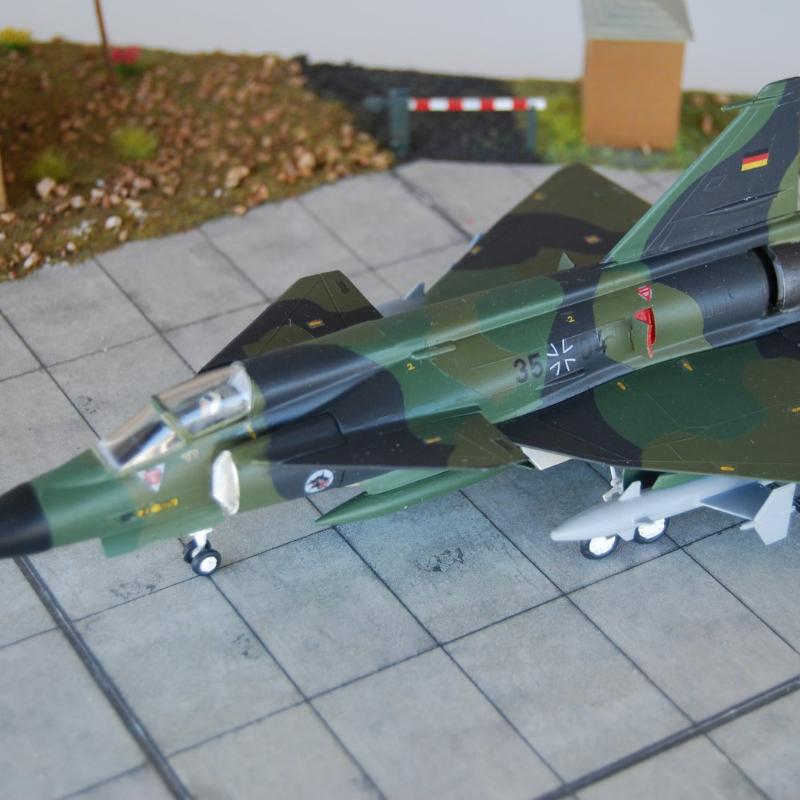
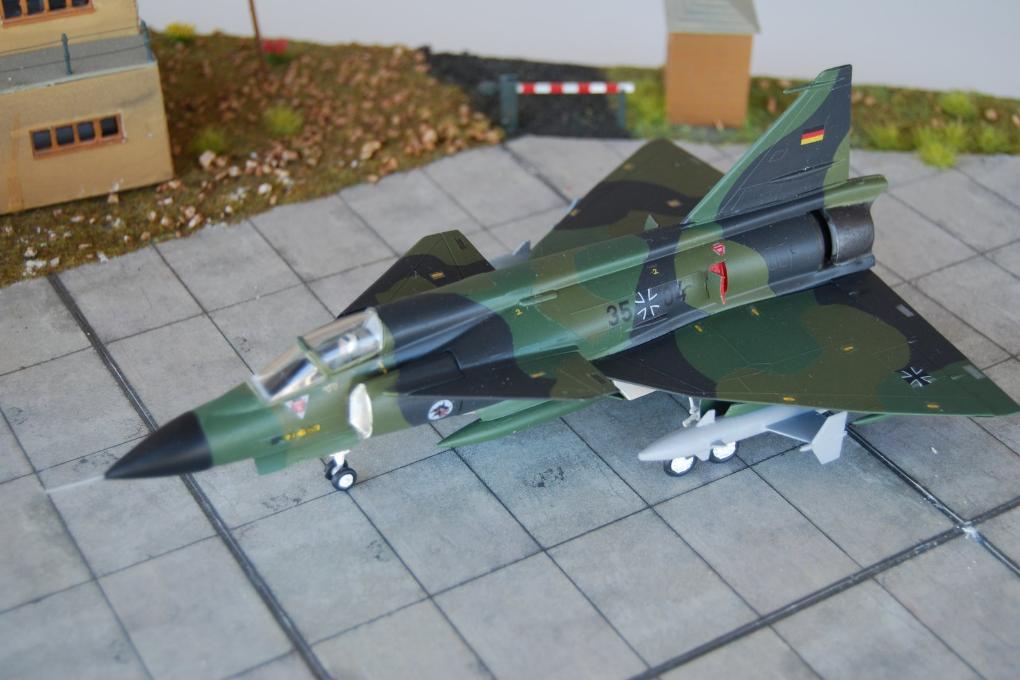
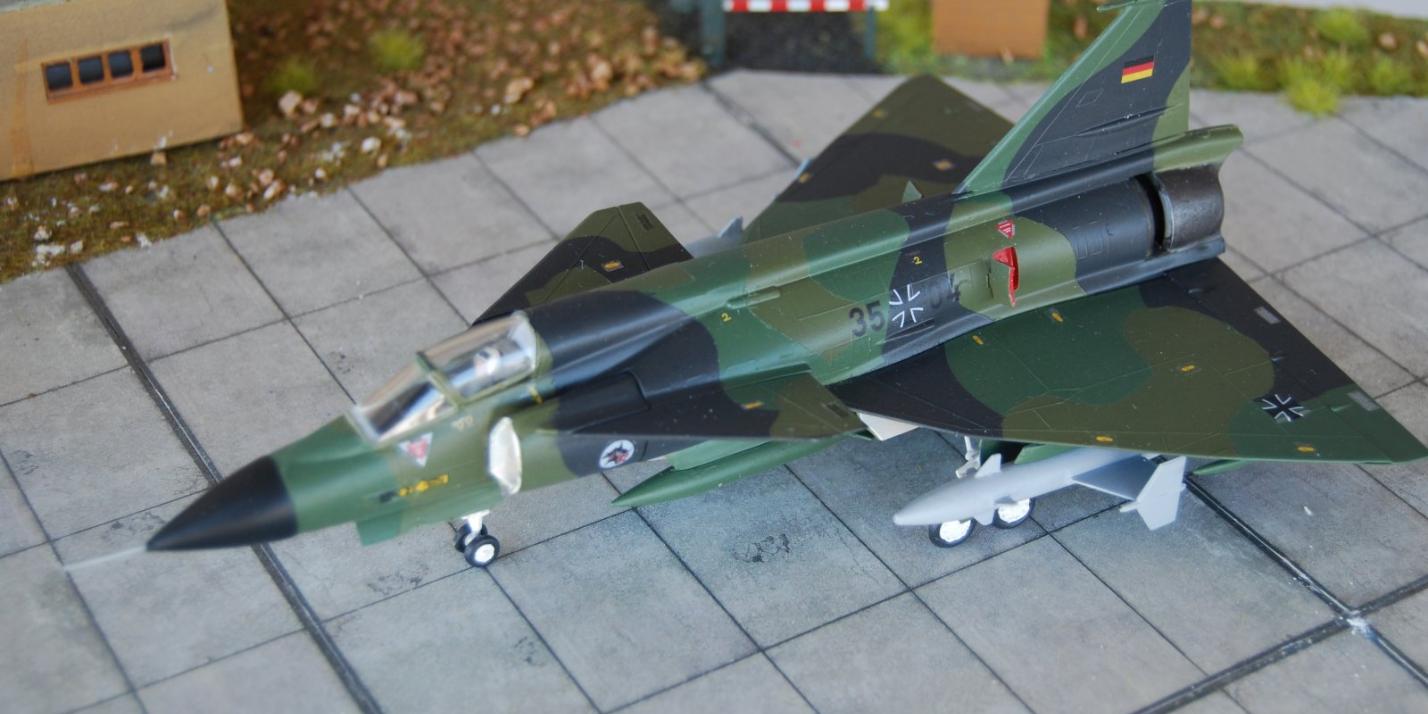
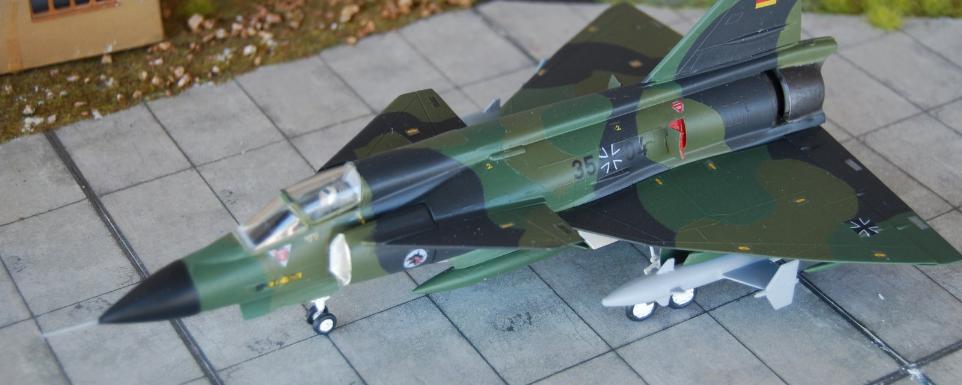
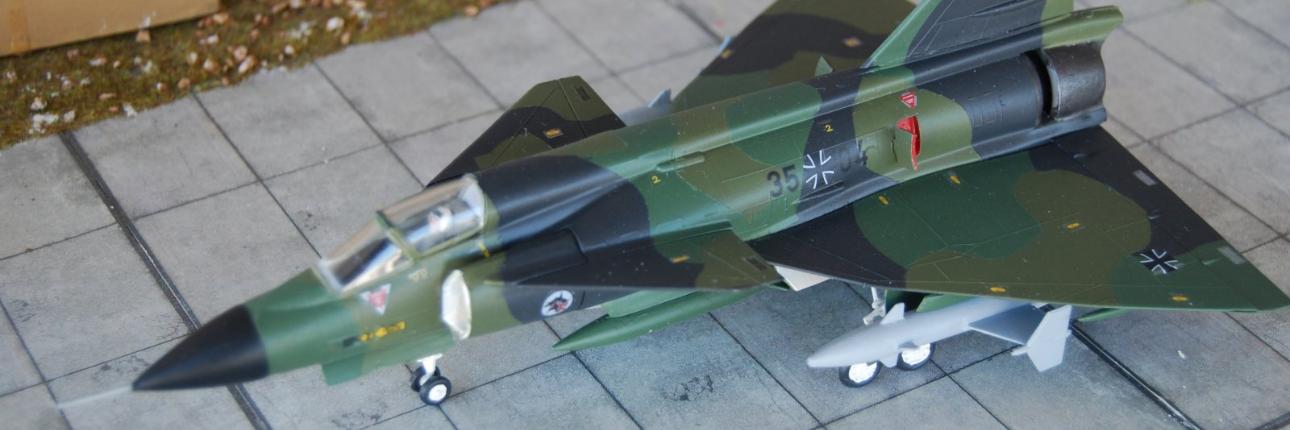
The model shows a Luftwaffe AJ37G "Viggen" in May 1983.

This is an older Airfix model which did fit quite good. Painted in Norm83 camo, the model was build OOB. Decals from HaHen were used.