Manufacturer: Revell
Scale: 1/720
Additional parts: scratch build parts
Model build: ~1995

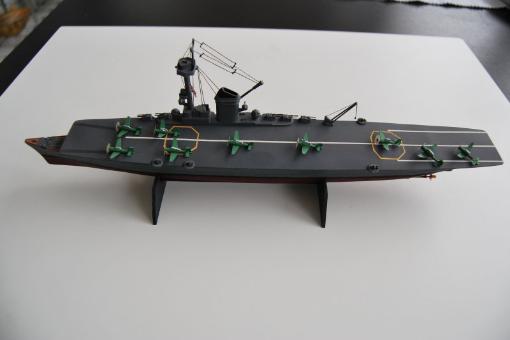
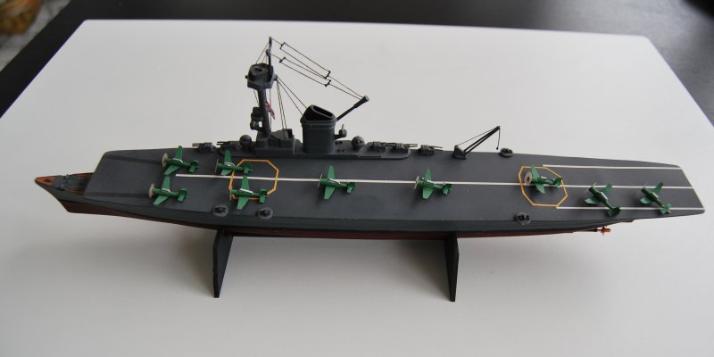
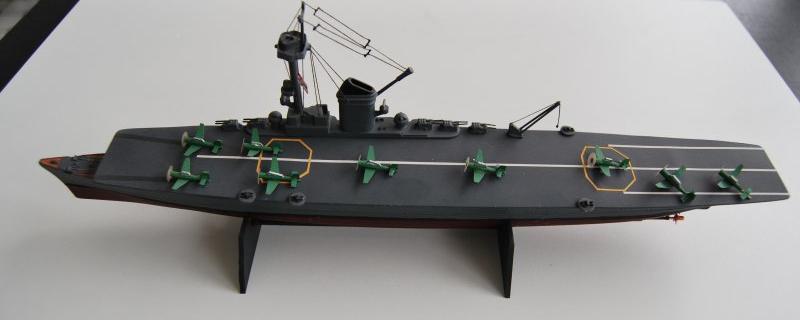
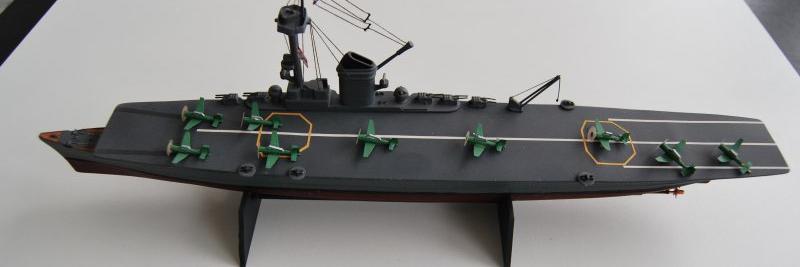
Manufacturer: Revell
Scale: 1/720
Additional parts: scratch build parts
Model build: ~1995
The icy Baltic wind whipped at Klaus Meyer's face, stinging his cheeks like a thousand needles. He hunched deeper into his worn peacoat, his gaze fixed on the skeletal form of the Weser, the unfinished carrier he was now tasked with towing to Königsberg. A ghost of its former self, the once-proud Seydlitz was a testament to shattered dreams – its flight deck a desolate expanse, its superstructure a skeletal silhouette against the leaden sky.
Klaus, a veteran tugboat captain, had witnessed the war's relentless tide turn against Germany. Now, in January 1945, with the Red Army closing in, desperation hung heavy in the air. The Weser, a project born of that desperation, was supposed to be a carrier, a symbol of renewed German might. Now, it was a hollow shell, a burden he had to drag across the treacherous Baltic.
The journey was fraught with peril. The skeletal form of the Weser offered little resistance to the relentless waves, tossing the tugboat, the " Adler," like a cork in a bathtub. The towline groaned under the strain, a constant reminder of the precarious balance between them. Every creak, every groan of straining metal sent shivers down Klaus' spine.
Days bled into nights, the only light a sliver of moon struggling to pierce the thick clouds. The crew, a motley bunch of young conscripts and weary veterans, worked tirelessly, battling fatigue and the ever-present fear of Soviet submarines lurking beneath the icy surface. Sleep was a stolen luxury, meals a hurried affair of stale bread and watery soup.
One night, a storm erupted with a fury that seemed to mirror the chaos engulfing their world. The Baltic churned, waves crashing against the Weser like battering rams. The towline, strained to its limit, snapped with a deafening crack. The Adler was thrown violently away, tossed about like a toy in the storm's fury. Panic threatened to rise in Klaus' chest, but years of experience kept him grounded. With a barked order, he steered the Adler, fighting for control, a desperate gamble to avoid being swallowed by the churning sea.
By some miracle, they managed to reattach the towline the next morning, the storm having subsided as abruptly as it had begun. The Weser, battered but still afloat, continued its slow, agonizing journey. Klaus knew it was a fool's errand. The war was lost, Königsberg on the brink of falling. Yet, there was a grim satisfaction in completing the task, a defiance against the inevitable.
Finally, after days that stretched into an eternity, they reached the frozen harbor of Königsberg. The city, a silhouette of smoke and flames under the relentless Soviet assault, mirrored the desolate state of the Weser. There was no fanfare, no celebration. The skeletal carrier was simply moored, a silent monument to a dream that died before it could take flight.
A few days later, the Soviets stormed the city. Klaus, watching from afar, saw the Weser scuttled by retreating German forces. It sank slowly, a watery grave for a ship that never saw battle. As the smoke cleared, revealing the skeletal form of the Weser half-submerged in the water, Klaus knew it was more than just a ship that had sunk. It was a symbol of a nation's shattered ambitions, a testament to the futility of war, and a chilling reminder of the heavy price they had all paid.

Among the many unrealized ambitions of the Kriegsmarine, few capture the imagination quite like the light aircraft carrier Seydlitz — a vessel born of desperation, adaptation, and the fading dreams of Germany’s naval power in the final years of the Second World War.
The Seydlitz began her life not as a carrier at all, but as the fourth ship of the Admiral Hipper–class heavy cruisers, sister to the Admiral Hipper, Blücher, and Prinz Eugen. Laid down at Deschimag AG Weser in Bremen in 1936, the ship was designed for long-range surface operations, carrying eight 20.3 cm guns and displacing 18,500 tons at full load.
By the outbreak of war in 1939, however, the priorities of the Kriegsmarine had shifted. After the loss of the Graf Spee and Bismarck, Grand Admiral Raeder’s vision of a balanced fleet collapsed under the weight of Allied sea control and the Luftwaffe’s dominance over air operations.
In this changing climate, the unfinished Seydlitz became a symbol of opportunity — a platform to fill Germany’s desperate need for sea-based air power.
By May 1942, Seydlitz was nearly complete as a cruiser — only her masts, cranes, and secondary armament remained unfinished. But as the Luftwaffe struggled to provide air cover for naval operations in Norway and the Arctic, the idea of converting the vessel into an aircraft carrier resurfaced.
Thus was born Project Weser I, an ambitious plan to transform Seydlitz into a CVL (light aircraft carrier) capable of operating twelve fighters and ten dive bombers.
The conversion called for the removal of her heavy guns and superstructure, replacing them with a 170-meter flight deck, two aircraft elevators, and a single catapult. Her distinctive funnel was to be retained, offset to starboard, and her hangars designed for rapid rearming and refueling — innovations inspired by Japanese carrier designs studied through Axis cooperation.
Work proceeded cautiously at Bremen between late 1942 and early 1943. By March, the main turrets had been stripped, and her superstructure had been razed down to the upper deck. The gutted hull — now little more than a floating shell — was then towed to Königsberg for final conversion work.
However, by the summer of 1943, the carrier project was effectively dead.
The collapse of Germany’s naval war made Seydlitz increasingly irrelevant. The Luftwaffe opposed diverting scarce aircraft and pilots to a naval air arm, while resources were being consumed by the army’s struggles on the Eastern Front. Even Graf Zeppelin, the Kriegsmarine’s first true aircraft carrier, languished incomplete at Stettin.
By June 1943, Seydlitz’s conversion was officially halted. The incomplete ship remained moored in Königsberg, stripped and silent — a hulking reminder of what might have been.
When Soviet forces approached the city in April 1945, the order was given to scuttle the vessel. Explosive charges detonated along her hull, sending the half-finished carrier to the bottom of the harbor.
After the war, the Soviets briefly examined the wreck of Seydlitz with interest, even raising portions of her superstructure in 1947. Yet the hull was too far gone to be salvaged, and her remains were scrapped in the early 1950s.
The model is an old Revell 1/720 Prinz Eugen kit, which was converted in a quite similar way than the original - the superstructure was removed and then a new one, including flight deck and island was build from plasic sheets and the original kit parts.
The Ju 87 dive bombers were made from toothpicks, paper and plastic parts (ok, hard to itendify, I know...)