Manufacturer: Huma
Scale: 1/72
Additional parts: none
Model build: Aug - Sep 2012
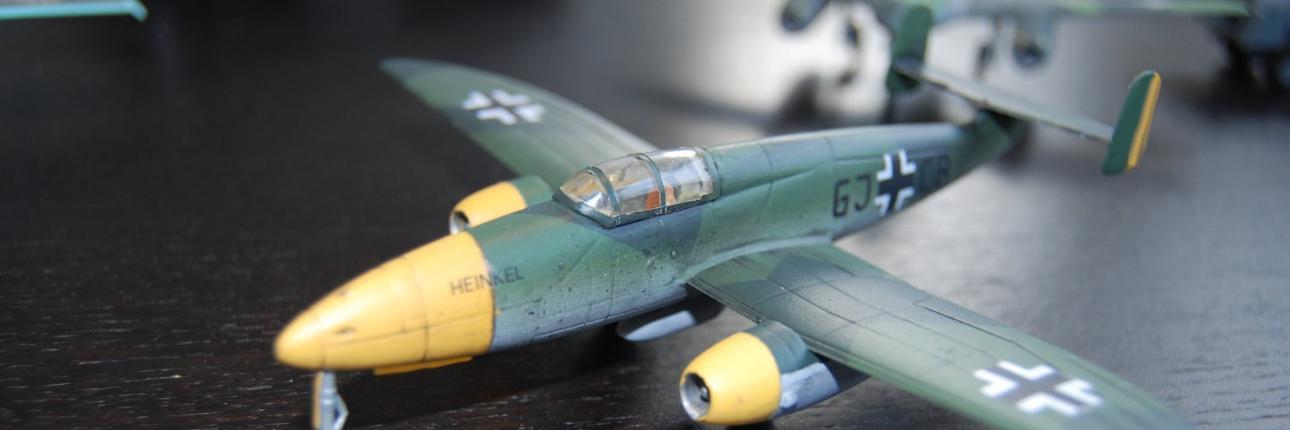
Manufacturer: Huma
Scale: 1/72
Additional parts: none
Model build: Aug - Sep 2012
Flight Sergeant Evans squinted into the early morning sun, his radar blaring a frantic warning. "Unidentified bogies! High speed, closing fast!" His heart hammered against his ribs. This wasn't the usual Messerschmitt rumble. This was something new, something terrifying.
Evans scrambled into his Spitfire, the familiar canvas cockpit a reassuring constant amidst the rising panic. He wasn't alone. The morning patrol, a mix of Hurricanes and Spitfires, roared to life, a swarm of angry hornets buzzing towards the threat.
Then they saw them – four sleek, charcoal darts streaking across the horizon. Unlike the lumbering bombers or the familiar Messerschmitts, these moved with an unnatural speed, a blur of sound and fury. They were Heinkel He 280s, the Luftwaffe's rumored jet fighters, finally taking to the skies over the Channel.
The ensuing dogfight was a ballet of desperation. Evans, a veteran of countless skirmishes, found himself outmatched. The He 280s screamed past, their 20mm cannons spitting fire that seemed to carve through the air itself. He barely dodged a burst that shredded the tail of a Hurricane flying beside him. The pilot, a young lad barely out of his teens, spun away, a plume of black smoke trailing his doomed aircraft.
Fury burned alongside fear in Evans' chest. He knew these jet fighters were a game changer. Their speed was undeniable, and though their maneuvers seemed less agile, their raw power was a terrifying prospect. He had to warn the others, had to buy his comrades some time.
Spotting a lone He 280 lagging behind the others, Evans saw his chance. He dove, adrenaline masking the G-force that pressed him into his seat. He opened fire, his tracers arcing towards the enemy's underbelly. The He 280 banked sharply, smoke billowing from one engine. Evans had hit his mark.
But the victory was fleeting. Two He 280s turned on him with a vengeance. He weaved through the hail of fire, feeling the familiar strain on his Spitfire as he pushed it to its limits. He glanced at his fuel gauge – the chase had eaten away at his reserves. Escape, not victory, became his priority.
He skimmed the waves, the white caps blurring into a dizzying kaleidoscope. The He 280s, hampered by their own fuel limitations, hesitated. They roared overhead, frustrated snarls in the sky, before turning back towards France.
Evans landed with a shudder, his hands shaking on the controls. He had survived, but the encounter left a cold dread in his gut. The He 280s were real, and they were a nightmare made flesh. He relayed his encounter to a tense debriefing room, the weight of his report hanging heavy in the air. The Battle of Britain had taken an unexpected turn. The skies were no longer the domain of propeller fighters alone. A new era of warfare had begun, and the outcome was far from certain.
The roar of the jet engines vibrated Lieutenant Schmidt's teeth as he rocketed towards the English coast. Unlike the familiar rumble of the Me 109, the He 280's whine felt alien, a high-pitched scream that sent shivers down his spine. Today was his first taste of combat in this revolutionary machine, a baptism by fire over hostile skies.
Four He 280s, sleek and deadly in their charcoal paint, sliced through the morning mist. Codenamed "Ghost Squadron," they were the Luftwaffe's secret weapon, a gamble against the valiant Spitfires and Hurricanes that dominated the skies. Their advantage: speed. Their Achilles' heel: fuel.
The radio crackled. "Achtung! Feindjäger!" (Enemy fighters!). Schmidt's hand tightened on the control stick. A swarm of Spitfires, their elliptical wings glinting like polished silver, rose to meet them. The He 280s held their formation, a silent ballet of steel and smoke.
Schmidt slammed the throttle forward. The world blurred into a canvas of greens and blues as the He 280 surged past the sound barrier. The Spitfires, caught off guard by the unexpected speed, struggled to keep pace. He felt the exhilaration of defying physics, a feeling he'd never experienced in a conventional fighter.
But triumph turned to terror as a red tracer arched through the air, spitting fire towards his wing. A Spitfire pilot, bolder than the rest, had managed to catch up. Schmidt banked sharply, the G-force pushing him into his seat, as the enemy's tracers danced around him.
He glanced at his wingman, Lieutenant Meyer. Smoke billowed from Meyer's He 280, a crimson gash marking a direct hit. The thrill of the jet vanished, replaced by a cold dread. This wasn't a training exercise. Here, mistakes were paid for in blood and fire.
Meyer's He 280 dipped, trailing smoke. Schmidt watched helplessly as it spun out of control, vanishing into the haze below. His throat constricted. Meyer had been more than just a wingman; they were childhood friends, inseparable since they'd first dreamt of flying.
A surge of anger fueled Schmidt's actions. He roared after the remaining Spitfires, unleashing a torrent of fire from his 20mm cannons. One Spitfire, caught in the hail of lead, burst into flames, spiraling down in a fiery trail.
But victory tasted like ash. Every maneuver, every twitch of the controls, burned fuel. The drop tank beneath his belly felt worryingly light. They had achieved surprise, but at what cost? Reaching their target, a heavily fortified airfield rumored to be testing a new bomber prototype, seemed like a distant dream.
Just as hope dwindled, the English coast appeared on the horizon. Relief flooded Schmidt, tinged with the bitter taste of loss. They were turning back, leaving the mission incomplete. The radios crackled again, this time with the Führer's voice, booming and furious.
Schmidt landed with a heavy thud, the He 280 a thirsty beast begging for fuel. He climbed out, shaken but alive. Three He 280s had limped back, a stark reminder of the price of pushing the boundaries of jet technology.
He stood amidst the refueling crew, the bittersweet scent of jet fuel filling his nostrils. They might have returned incomplete, yet they had proven the He 280's potential. The Ghost Squadron might have lost its bite today, but it wouldn't be silenced. The future of the skies belonged to jet fighters, and Schmidt, fueled by grief and determination, would be a part of it.

The Heinkel He 280 was historically the world’s first purpose-built jet fighter aircraft, with its maiden powered flight taking place on 30 March 1941. In reality, only nine prototypes were completed, and the program was eclipsed by the more advanced Messerschmitt Me 262. However, in this alternative history, the He 280 entered series production and became the first operational jet fighter of the Luftwaffe.
Following the successful flight of the experimental He 178 on 27 September 1939, the Luftwaffe’s high command grew increasingly interested in jet propulsion. Encouraged by Ernst Heinkel’s team, the Air Ministry ordered development of a combat-ready fighter to exploit this revolutionary technology.
The He 280 prototype flew as early as February 1940—a year earlier than in actual history—and demonstrated promising speed and climb performance, albeit with limited range. Despite unresolved reliability concerns with the HeS 8 turbojet engines, production was authorized in mid-1940.
The first production He 280s entered Luftwaffe service in August 1940, just as the Battle of Britain was at its height. The initial A-model carried three 20 mm MG 151 cannons, providing formidable firepower compared to the contemporary Bf 109E. Its range, however, was far shorter, making deep escort missions impossible.
In response, the He 280B was developed with enlarged internal fuel capacity and provision for drop tanks, tripling the aircraft’s combat radius to over 650 miles (1,046 km).
On 13 September 1940, four He 280s conducted the type’s first operational sortie, a fighter sweep over southern England. In the ensuing skirmish, they downed two Hawker Hurricanes and one Supermarine Spitfire without loss. In the following weeks, further sweeps were flown, though the type’s fragile engines demanded constant servicing. Operational availability rarely exceeded 40%, significantly lower than piston-engine fighters.
Three He 280s were lost in combat during the Battle of Britain. Two were destroyed over the English Channel, while one aircraft was forced to belly-land near Royal Tunbridge Wells. The wreckage of this fighter was salvaged by the RAF and transported to Farnborough, where British engineers undertook detailed evaluation of the jet technology.
Although the He 280 provided the Luftwaffe with a dramatic early advantage in aerial combat, its operational limitations and unreliable powerplants prevented it from becoming the decisive weapon Heinkel envisioned.
By late 1942, the introduction of the superior Messerschmitt Me 262 rendered the He 280 increasingly obsolete. Production was gradually scaled back, and the program was officially terminated in April 1943.
In total, approximately 240 He 280s were built across all variants, with the type serving primarily as an interim jet fighter and combat testbed until replaced by the Me 262.
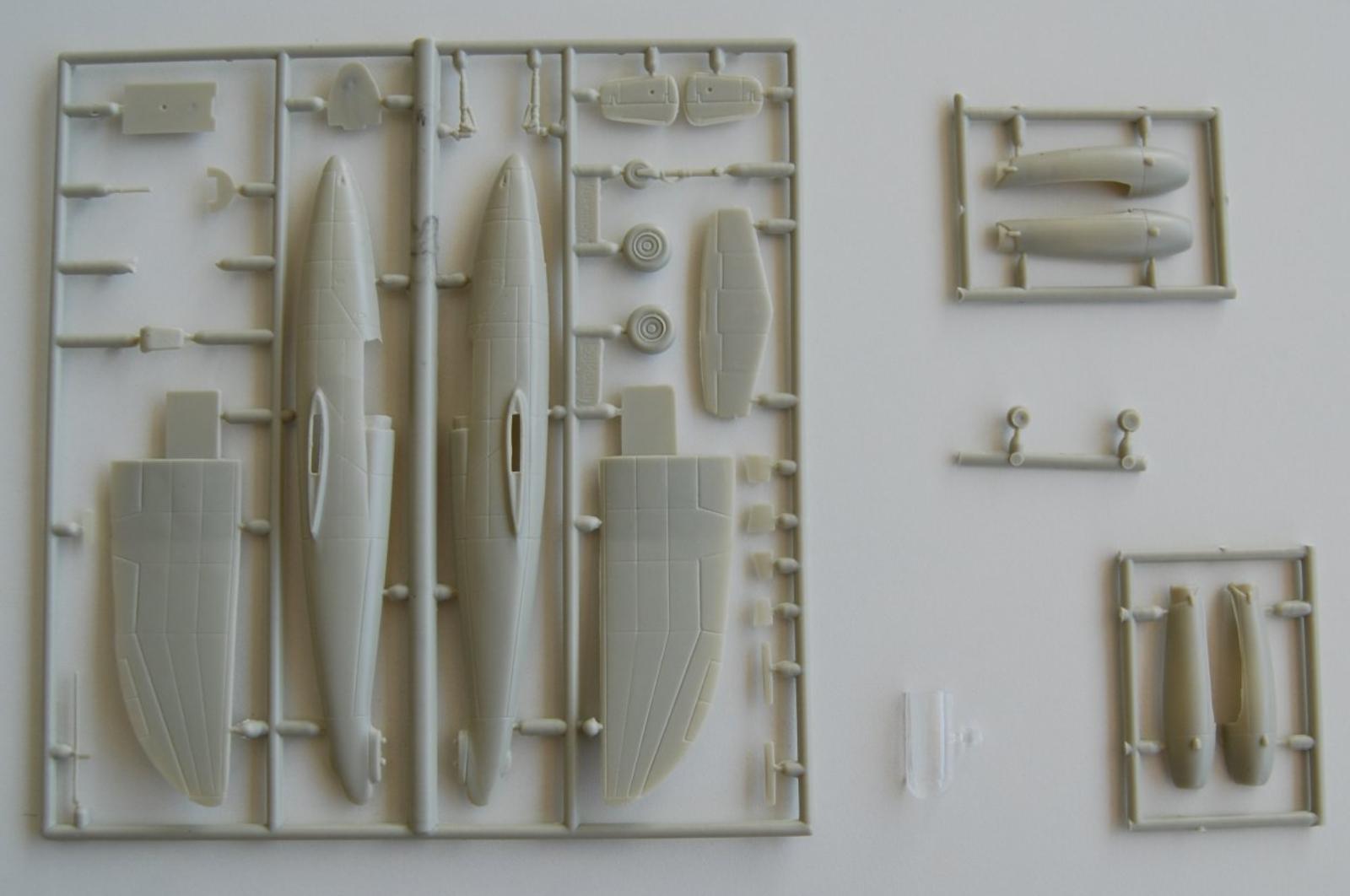
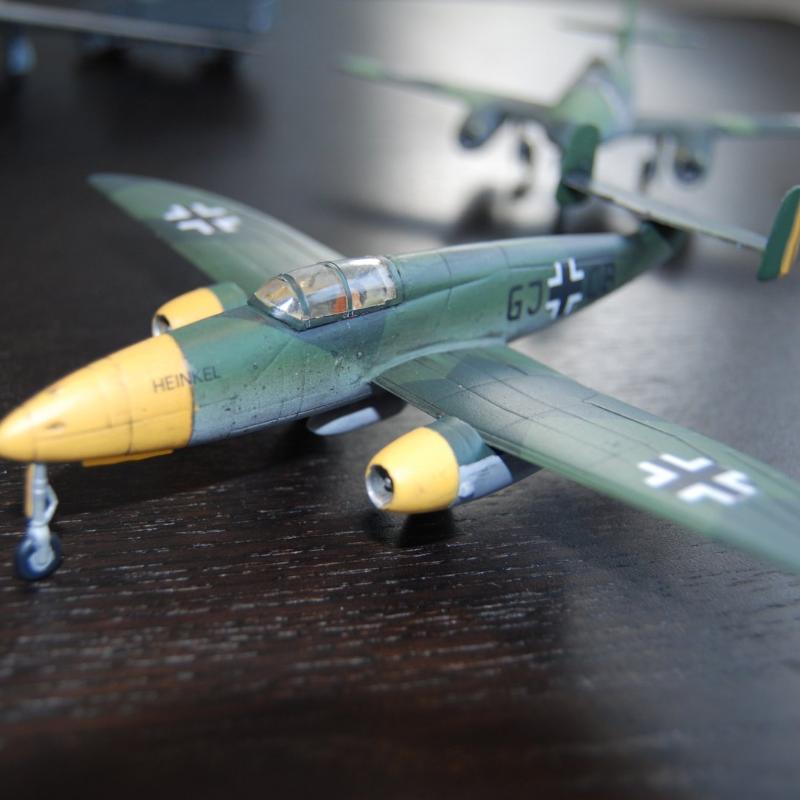
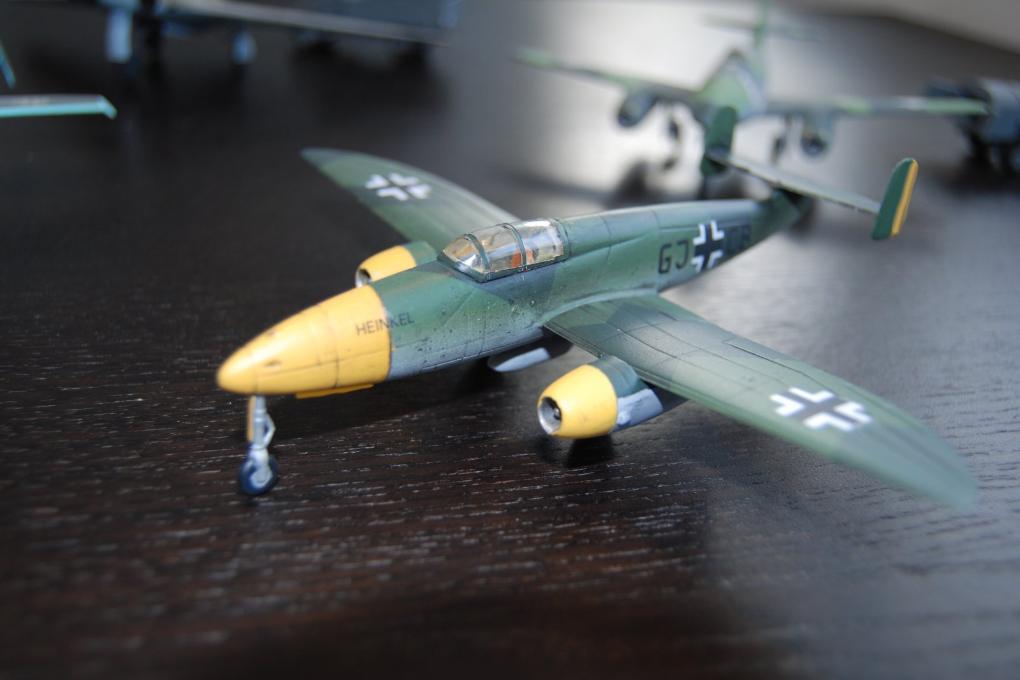
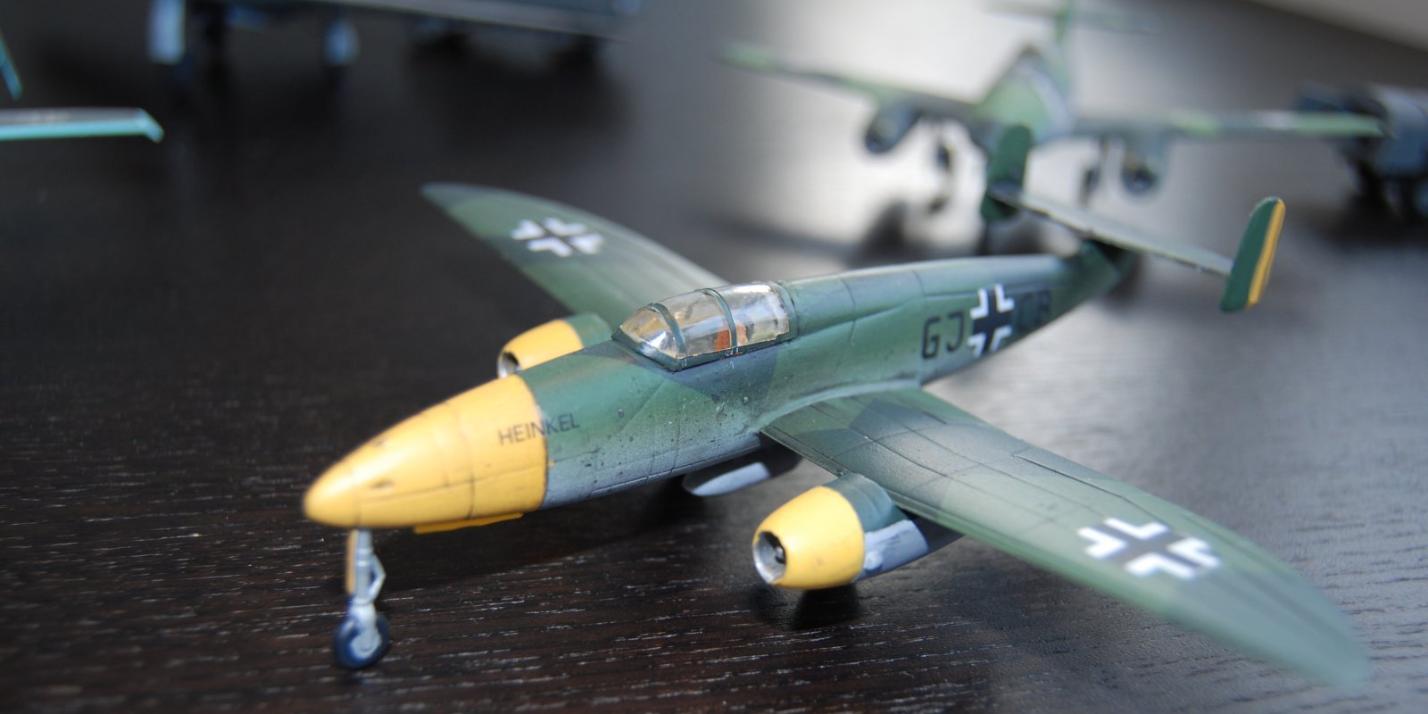
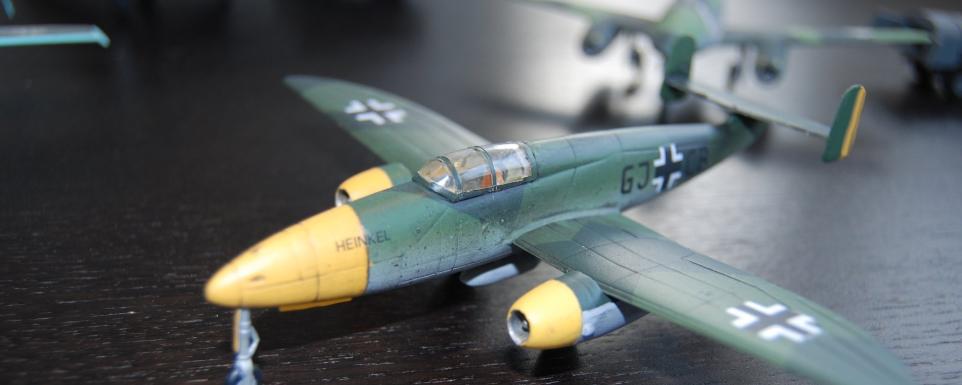
The model is a 1/72 Huma kit. Huma was a German manufacturer who produced a lot of German prototype aircraft of WW2. The kit is pretty basic, with less than 30 parts. It was build OOB, just adding an adiditonal drop tank. It was painted with Revell Aqua colors and I tried a little bit of weathering to it for the first time. Despite what I read about the Huma decals, they were quite good and were extended with some additional decals.