Manufacturer: 3D print
Scale: 1/700
Additional parts: PE parts
Model build:
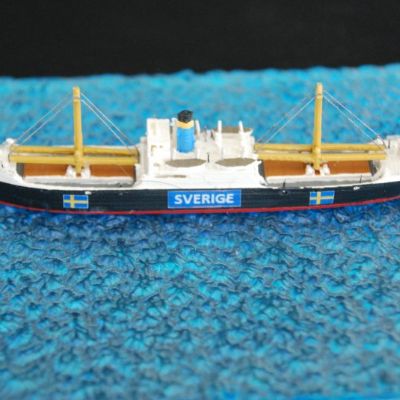
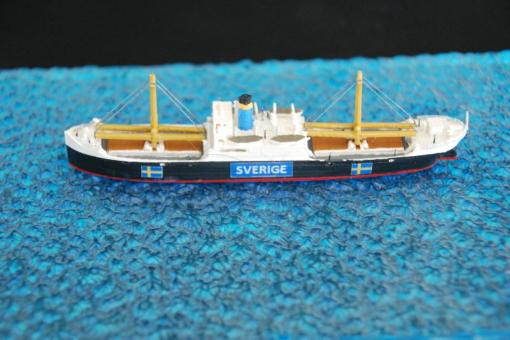

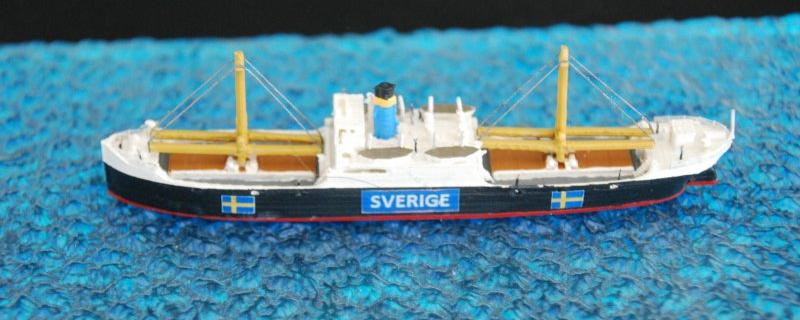
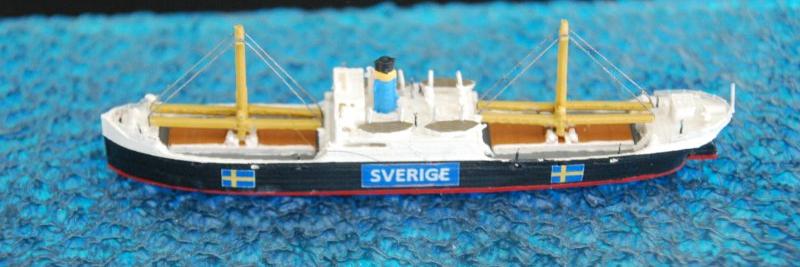
Manufacturer: 3D print
Scale: 1/700
Additional parts: PE parts
Model build:
Captain Magnus Larsson squinted through the salty spray, the Baltic wind whipping his worn beard. The Ramsö, a creaking testament to a bygone era, carved its path through a sea strangely calm for this time of year. Unlike the modern warships bristling with weaponry, the Ramsö relied on Magnus's weathered charts and the sextant bouncing in his calloused hand. Its hold wasn't filled with munitions or soldiers, but a cargo of unassembled dreams – flat-pack furniture from a Swedish company destined for ports around the Baltic.
Tonight, however, the Ramsö wasn't delivering just furniture. Hidden beneath a stack of chairs, a young Estonian woman named Elara huddled in fear. Elara, a talented mathematician with a mind for codes, had become a target for both German and Soviet forces. With whispers reaching Stockholm of her plight, the Swedish government devised a daring plan. The Ramsö, a ship deemed harmless by all sides, would become Elara's unlikely escape route.
As dusk settled, painting the sky in fiery hues, the Ramsö approached the Estonian coast. The pre-arranged signal – a single flickering light from a hidden cove – sent a jolt of nervous excitement through Magnus. He steered the ship closer, his heart hammering against his ribs.
Suddenly, a spotlight lanced through the gathering darkness, revealing a Soviet patrol boat closing in. Panic threatened to consume Magnus, but years of navigating treacherous waters had steeled his nerves. With a barked order, the crew sprang into action, hoisting the massive Swedish flags painted on the Ramsö's side. The rickety freighter, plastered with the symbol of neutrality, looked even more comical under the spotlight.
The Soviet patrol boat hailed them, its message a curt demand to identify themselves. Magnus, his voice steady despite his pounding heart, calmly announced himself as Captain Larsson of the Swedish freighter Ramsö, simply delivering furniture to a customer on the Estonian coast.
The spotlight lingered for a tense moment, then the Soviet boat grunted a gruff acknowledgment and moved on. Relief washed over Magnus as he steered the Ramsö into the hidden cove. Elara emerged from her hiding place, tears glistening in her grateful eyes.
With Elara safely aboard, Magnus expertly navigated the Ramsö back into open waters. The little freighter, carrying not just furniture but a life saved, continued its journey under the cloak of night. The war raged on around them, but for a brief moment, on a small Swedish freighter, a flicker of humanity had defied the darkness. The Ramsö, a symbol of neutrality, had become a vessel of hope, proving that even the most ordinary of ships could play an extraordinary role in extraordinary times.

1918–1946
The small Swedish freighter Ramsö began her life far from Scandinavia. Launched in late 1918 at an American shipyard as part of the Emergency Fleet Corporation’s Design 1020 “Laker” class, she was one of hundreds of utilitarian cargo ships built to keep wartime commerce moving. The Armistice came before she ever saw military service, and like many of her sisters she was quietly laid up—too new to scrap, too ordinary to attract buyers.
Her path from the United States to Sweden remains shrouded in bureaucratic fog. Some records suggest she was acquired through an intermediary in 1924, another claims she was seized as compensation for unpaid war debts, and one persistent rumor insists she was purchased for a symbolic $1 because the Americans wanted the berth space back.
Whatever the truth, by 1926 the Ramsö officially appeared in Swedish shipping registries, newly painted and ready for Baltic trade.
When war returned to Europe in 1939, Sweden declared neutrality, but neutrality did not mean safety. The Baltic Sea became a maze of minefields, prowling submarines, and unpredictable “accidents.”
The Ramsö, by now a well-worn but reliable coastal freighter, carried civilian cargo, mostly furniture and manufactured household goods from a well-known Swedish company (whose name curiously disappears from post-war archives). Her routes connected Sweden to Finland, Estonia, Latvia, and occasionally German-occupied Poland. The ship served customers on all sides of the conflict, provided they accepted the risks.
To avoid being mistaken for a military vessel, the Ramsö was repainted in dramatic fashion:
enormous Swedish flags stretched across both hull sides, visible from several kilometers away. Contemporary photos, most lost during post-war censorship, reportedly show her looking like a floating national billboard.
Despite constant hazards, she gained a reputation as a lucky ship:
In 1940 she narrowly avoided a drifting mine off Gotland.
In 1941 she was stopped and inspected twice by Soviet patrol craft, but released thanks to her obvious neutrality markings.
In 1943 a German aircraft misidentified her at dusk, dropping two bombs that missed by several hundred meters.
In 1944 she sailed through the aftermath of a major naval battle but remained unharmed.
Crewmen claimed the huge Swedish flags were “the only armor we needed.”
By the end of World War II, the Ramsö was hopelessly outdated. Her slow, single-expansion steam engine was inefficient, her hull plating was worn thin, and her cargo capacity too small for the booming post-war economy. But she had survived the conflict unscathed—a rare achievement for a merchant vessel in the Baltic.
She made her final journey in early 1946, delivering one last shipment of furniture to Gdańsk. Upon returning to Stockholm, she was quietly withdrawn from service and sold for scrap.
No museum preserved her. No monument was built in her honor.
But among Baltic sailors, stories of the Ramsö - the “unsinkable Swedish flag” - lived on for decades.
This is a 3D printed model of a WW1 US Cargo ship (EFC 1020) "Laker". orignally in 1/350 scale, it was printed at 50% size. Some additional PE parts & crew were added. Painted with Revell Aqua Colour, decals were self made.
The following 3D model was used:
1/350 WW1 US Cargo ship (EFC 1020) "Laker" (Published on Feb 12, 2019)